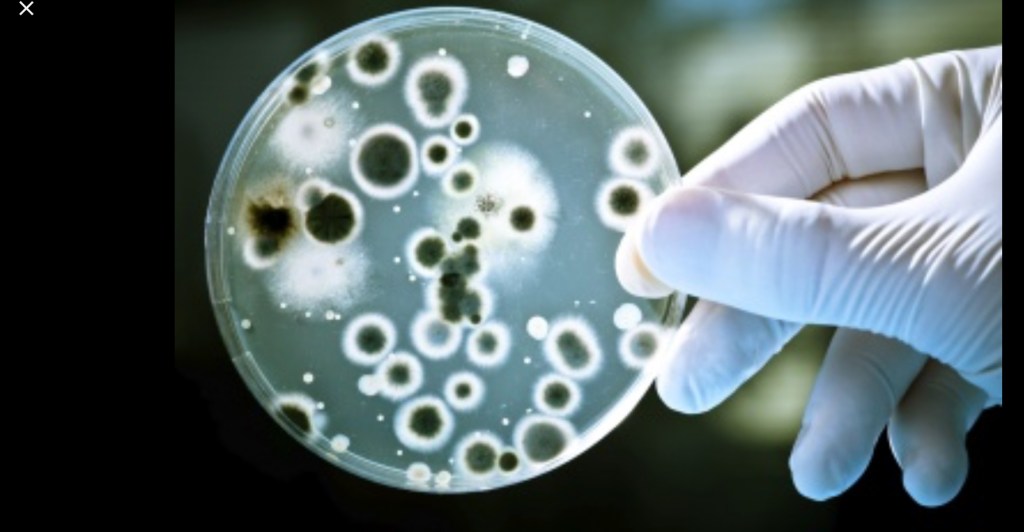
bacteria were discovered by a dutch merchant named Anton von Leeuwenhoek. Anton’s hobby was making microscopes, while looking at scrapings of his teeth, he noticed small wormlike organism ( bacteria).
Bacteria are prokaryotes. The genetic material in their cells is not contained in a nucleus. In addition to lacking a nucleus, the cells of bacteria also lack many other structures.
Structures in a typical bacterial cell 👇🏻
The cell wall protects the cell. Inside the cell wall is the cell membrane ,which controls what materials pass in and out of the cell. The region inside the cell membrane is the cytoplasm, that contains a gel-like fluid that moves structures throughout the cell. Located in the cytoplasm are tiny structures ( ribosomes ), chemical factories where proteins are produced. A bacterial cell may also have a flagellum, a long whiplike structure that helps a cell 🦠to move. If a bacterial cell lacks the flagellum it can be carried from place to place by air, water or even organisms !!
cell shapes:
If you want to know how a bacterial cell looks like just look 👀 to their following shapes , there are three basic shapes: spiral,spherical, or rodlike.
cell sizes:
Bacteria vary greatly in size. The largest known bacterium is about as big as the period at the end of this sentence. For example, the spherical strep throat bacteria 🧫 is about 0.5 to 1 micrometer in diameter. A micrometer is one millionth of a meter!!
Bacteria get energy by either making food 🥘 or eating other organisms, and can reproduce asexually or sexually.
Do you know that when the bacteria 🦠 have plenty of food, the right temperature, and other suitable conditions, they thrive and reproduce often either asexually or sexually!! And did you know that many of the bacteria living in your body actually keep you healthy? For example your intestines teem with bacteria. Some help you digest your food. Some make vitamins that your body needs! Others compete for space with disease-causing organisms. They prevent the bacteria from attaching to your intestines and making you sick 🤒.
Scientists 🥼 use certain bacteria to make medicines and other substances. By manipulating the bacterias genetic material, scientists 👩🔬 can cause bacteria to produce human insulin. Although healthy people can make their own insulin, those with some types of diabetes cannot. Many people with diabetes need to take insulin daily! Thanks to bacterias fast rate of reproduction, large numbers of insulin-making bacteria can be grown in huge vats . The human insulin they produce is then purified and made into medicine. So, thanks bacteria 🦠🙏🏻
 Bacteria